
If you’re shopping for a 2 car metal garage, you’ll notice one thing fast: there’s no single “standard” 2-car size. What looks right on a spec sheet might feel tight once you’re opening doors, carrying gear, or trying to squeeze past a workbench.
Some folks want just enough room to park. Others want parking plus storage, tools, a workbench, and space to move around without doing the sideways shuffle.
In this guide, we’ll break down the most common 2 car garage dimensions, what they feel like in real life, and how to choose a size and layout that fits your vehicles and your routine.
Quick rule that helps: Your ideal garage size depends on your current vehicle width and how much storage you want inside.
Front Entry vs Side Entry Garages (What’s the Difference?)
This is one of the first decisions that changes everything—how you drive in, how far apart you space your doors, and how your site needs to be laid out. One is not better than the other, it just comes down to what fits your lot and your preferences.

What a Front Entry Garage Is (Left Photo)
Front entry means your overhead garage doors are placed on the front gable end. This is one of the most common and simplest approaches you’ll see out on the market.
Pros:
Work well on smaller lots
Clean, symmetrical look
Better water management
More usable space at the rear
Simpler driveway layout
Cons:
Depth matters more
Less separation between vehicles
More standard appearance
What a Side Entry Garage Is (Right Photo)
Side entry means the doors are placed on the side of the building, which can create a cleaner “front” view and a layout that feels more custom.
Pros:
Great for larger or wider lots
More natural fit for vehicle depth
More custom, high-end look
Easier to dedicate a full wall for storage or workshop
Better separation between vehicles
Cons:
Requires more site space
Water runoff over the garage doors
Driveway layout can be more complex
Not ideal for every property
The 3 Most Arguably Popular 2 Car Garage Sizes (And Why Depth Matters)
If you’re looking for a shortcut answer to your problem, these three sizes cover most builds we build and install—smallest that works, the most common “standard”, and the “room to breathe” option. Arguably, if you have the room to build bigger on your lot, do it. It’s not one of those things you’ll regret because space miraculously fills up over the years when you don’t think it’ll happen.

Smallest That Still Works: 20' x 30' (600 sq ft)
This is often the entry point for a true 2 car garage that still feels functional.
Fits two average-size vehicles parked side by side
Allows for basic clearance at the front or rear
Works best when storage needs are minimal
Depth reality: With most vehicles taking up 15'–18', a 30' depth gives you room for a small buffer in front of or behind the vehicles. It’s usable, but space needs to be planned carefully.
Best for: Smaller lots, budget-focused builds, and owners who mainly want covered parking
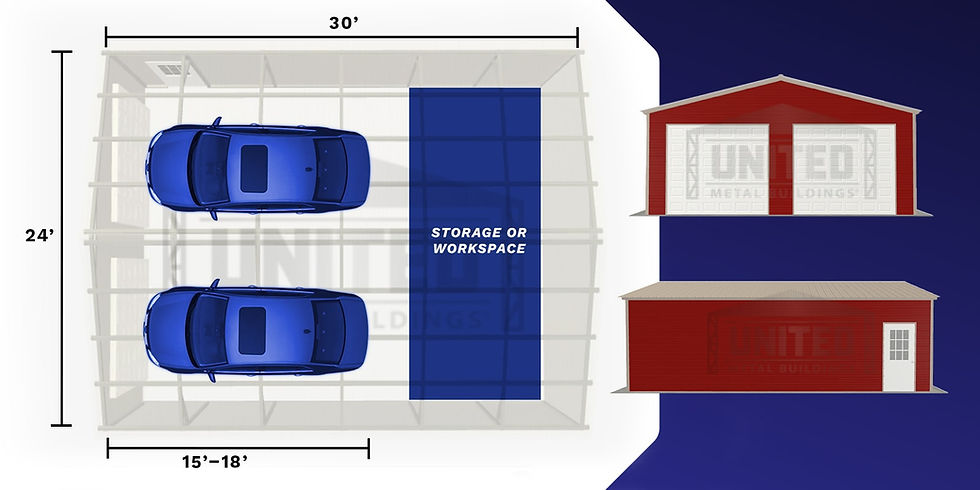
The Most Common “Standard” Size: 24' x 30' (720 sq ft)
This is where many people land once they realize they want comfort, not just fit.
Easier door clearance and walking space
Enough depth to add shelving or storage without crowding vehicles
More forgiving for SUVs and midsize trucks
Depth reality: A 30' depth at this width allows vehicles to sit comfortably while leaving room for storage along the front or back wall. It’s a balanced layout that works for most daily routines.
Best for: Homeowners who want parking plus storage without going oversized.

The “Room to Breathe” Option: 30' x 40' (1,200 sq ft)
This size shifts the garage from parking-only to multi-purpose space.
Comfortable parking for two vehicles with wide clearance
Space for a workbench, tool storage, or hobby area
Room to grow into over time
Depth reality: At 40' deep, you can dedicate zones—parking in one area and storage or workspace in another. Longer vehicles no longer dictate the entire layout.
Best for: Trucks, projects, equipment, and anyone who wants their garage to work as hard as they do.
Overhead Garage Door Sizes (One Big Door vs Two Doors)
Option 1 — One Extra-Wide 16' Door
Advantages: easier for wider turning, clean look, fewer door systems to maintain
Disadvantages: if one door fails, both bays are affected; can feel tighter inside if layout isn’t wide enough.
Option 2 — Two Doors (9' or 10' Wide Each)
Advantages: easier daily parking alignment, redundancy if one door has issues, classic “two bay” look.
Disadvantages: center post/spacing, slightly more hardware, can limit wide-entry use cases.
Your Move: Get a Size Recommendation Based on Your Vehicles
Once you know what you’re parking and how you plan to use the space, getting the right garage size gets a lot easier. If you’re unsure, that’s completely normal. A quick conversation can help confirm whether you’re on the right track or save you from going too small.
You can always reach out to us directly through our online contact form, give our main office a call at 309-278-8000, or chat with our team using online chat during normal business hours. We’re happy to talk through vehicle sizes, storage needs, door layouts, and anything else you’re considering.
If you already feel confident in the direction you want to go, you’ve got a few easy options. You can start designing your building in our 3D builder, request a quote, or use our dealer locator to connect with one of our authorized dealers near you for a more personalized, local experience.
No matter which path you choose, you’re never on your own. We’re here to help guide the process, answer questions, and make sure your garage fits the way you actually plan to use it.


Comments